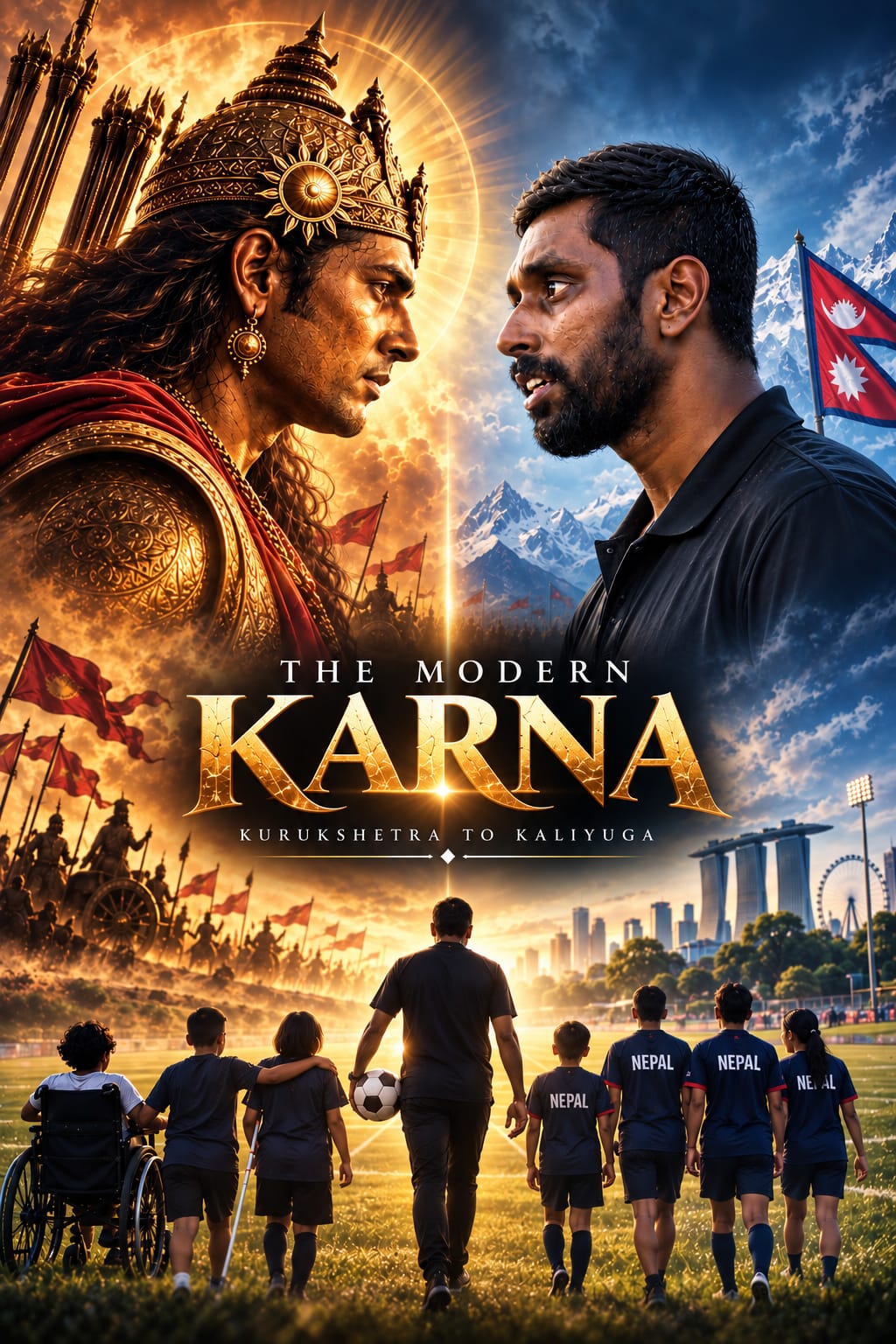
Inspired by the journey of Kumaran Arumugam
> “Every age has its Mahabharata. The names change, the weapons change, but Dharma still waits for those courageous enough to defend it.”
In the ancient Mahabharata, Karna was perhaps the greatest warrior never crowned. He was born with the brilliance of the sun, yet abandoned before he could know a mother’s embrace. He possessed unmatched talent, but the world judged him by where he came from instead of who he was. His life became a painful contradiction—a hero whose loyalty chained him to the wrong side of history.
But what if Karna lived today?
What if the warrior of generosity, resilience, and sacrifice was born not in Hastinapura, but in modern Singapore? What if, instead of standing beside Duryodhana, he chose to stand beside Dharma?
That is the story of Kumaran Arumugam.
As a young boy, Kumaran was not the image of the compassionate teacher people know today. He has openly described himself as impatient, hot-tempered, and someone who frequently got into fights. The troubled teenager he once was could never have imagined dedicating his life to children with disabilities and becoming a mentor to hundreds of young lives. His transformation became so remarkable that his journey was later featured by CNA as the story of a troubled teen who found his calling through special education.
Every Mahabharata begins with suffering.
Karna’s began with abandonment.
Kumaran’s began with searching for purpose.
Football became his first battlefield. It taught him discipline, sacrifice, and the relentless pursuit of excellence. He dreamed of playing professionally, spending years competing in Singapore’s football leagues while chasing a future that seemed within reach. Yet destiny had other plans. Injuries came. Opportunities slipped away. The dream that once defined him slowly transformed into something greater.
Most people believe losing a dream is the end of a story.
For warriors, it is only the beginning.
During his National Service, Kumaran encountered a young boy with special needs who loved sport but had no one to teach him. That single encounter changed the direction of his life forever. He chose education over professional football and dedicated himself to becoming an Adaptive Physical Education teacher, believing that every child deserved the joy of movement and the dignity of belonging.
That choice was his first step toward Dharma.
Today, his Kurukshetra is not filled with chariots.
It is filled with wheelchairs.
White canes.
Hearing aids.
And children who have spent too much of their lives being told what they cannot do.
Every morning he walks into Lighthouse School, he enters a battlefield invisible to the world. There are no conch shells announcing war, only classrooms where students quietly battle fear, anxiety, and society’s expectations. Some victories are measured not by goals scored, but by a child taking independent steps, throwing a ball for the first time, or discovering the confidence to say, “I can.”
Those moments are greater than any trophy.
The ancient Karna was called Daanveer—the greatest giver. Kings sought his wealth, and he never allowed anyone to leave empty-handed.
The modern Karna gives something even more precious.
He gives belief.
Belief to the visually impaired student who thinks sport is impossible.
Belief to the deaf footballer who dreams of wearing the national jersey.
Belief to the child whose disability has become the first thing others notice.
Gold can be spent.
Hope cannot.
His journey did not stop in Singapore.
Across the Himalayas, another calling awaited him. As Coach of the Nepal Deaf Men’s and Women’s National Football Teams, Kumaran found another family—athletes who communicate through signs, determination, and an unbreakable spirit. The world hears silence when they walk onto the field. He hears thunder.
He does not coach them because they are deaf.
He coaches them because they are warriors.
Together they train with limited resources, overcome financial struggles, and pursue international competition carrying the hopes of an entire deaf community. Every match becomes more than football—it becomes a declaration that disability will never define destiny.
This is where the story diverges from the Mahabharata.
The question scholars have asked for centuries remains unanswered:
What if Karna had stood with the Pandavas?
The original Karna chose loyalty to Duryodhana because gratitude meant everything to him. It was a noble choice with tragic consequences. His heart was righteous, but his allegiance placed him against Dharma.
The modern Karna chooses differently.
He keeps Karna’s humility.
He keeps Karna’s generosity.
He keeps Karna’s resilience.
But he offers all of it to righteousness.
His Pandavas are not princes.
They are the marginalized.
The forgotten.
The children with disabilities.
The deaf athletes.
The young people who simply need one adult to believe in them before they learn to believe in themselves.
His armour is no longer the divine Kavacha Kundala.
It is integrity.
No criticism can pierce it.
No failure can remove it.
His bow is not the celestial Vijaya.
It is education.
His arrows are patience, compassion, discipline, and relentless hope.
Every lesson he teaches is an arrow against ignorance.
Every training session is an arrow against inequality.
Every child who discovers confidence is another victory for Dharma.
Kaliyuga is often described as the age where righteousness survives on only one leg. Greed is celebrated. Kindness is mistaken for weakness. Service is overshadowed by fame.
Yet the Mahabharata teaches that Dharma never disappears—it simply waits for ordinary people to protect it.
Kumaran does not wear a crown.
He wears a whistle around his neck.
He does not sit upon a throne.
He kneels beside a child learning to stand.
He does not seek to be remembered as a hero.
He seeks to ensure others never feel forgotten.
Perhaps that is the greatest rewrite of Karna’s destiny.
The ancient Karna died protecting loyalty.
The modern Karna lives protecting hope.
And if Vyasa were to write the Mahabharata again in this age, perhaps he would remind us of one eternal truth:
> A true warrior is not the one who defeats the world. A true warrior is the one who heals it, one life at a time